Concrete Slab Calculator
A 10×10 ft slab poured 4 in thick needs about 62 80-lb bags of concrete, or 1.36 cubic yards of ready-mix — that's roughly 5,000 lb of concrete.
Concrete needed for common slab sizes
| Slab size | Cubic feet | Cubic yards | 50-lb bags | 60-lb bags | 80-lb bags |
|---|---|---|---|---|---|
| 4×4 ft, 4 in | 5.9 cf | 0.22 | 16 | 14 | 10 |
| 6×6 ft, 4 in | 13.2 cf | 0.49 | 36 | 30 | 23 |
| 8×8 ft, 4 in | 23.5 cf | 0.87 | 63 | 53 | 40 |
| 10×10 ft, 4 in | 36.7 cf | 1.36 | 98 | 82 | 62 |
| 12×12 ft, 4 in | 52.8 cf | 1.96 | 141 | 118 | 89 |
| 10×20 ft, 4 in | 73.3 cf | 2.72 | 196 | 163 | 123 |
| 20×20 ft, 4 in | 146.7 cf | 5.43 | 392 | 326 | 245 |
| 24×24 ft, 4 in | 211.2 cf | 7.82 | 564 | 470 | 353 |
| 12×12 ft, 6 in | 79.2 cf | 2.93 | 212 | 176 | 132 |
| 20×24 ft, 5 in | 220.0 cf | 8.15 | 587 | 489 | 367 |
Includes 10% extra for spillage and an uneven subgrade. Bag counts round up to the nearest whole bag.
How the math works
A slab is a rectangular prism, so the volume is just length times width times thickness. The trick is that slabs are usually measured in feet across but inches thick, so the thickness gets converted before multiplying, and the whole thing gets converted from cubic feet to cubic yards or bags at the end.
cubic yards = cubic feet ÷ 27
bags = (cubic feet × 1.10) ÷ bag yield
Bag yields are the manufacturer figures for placed concrete: 0.375 cubic feet from a 50-lb bag, 0.45 from a 60-lb bag, 0.60 from an 80-lb bag. The weight figure uses concrete's typical placed density of about 150 lb per cubic foot, before the waste allowance.
Why slabs actually crack
Most slab cracking traces back to one of three things: joints spaced or shaped wrong, pouring in weather the mix wasn't ready for, or a subgrade that couldn't support the slab evenly. Volume math doesn't touch any of these, but they decide whether the slab you just calculated lasts.
Joint spacing has two rules, not one
Control joints are commonly sized at 2 to 3 times the slab thickness in inches, read as feet — a 4-inch slab gets joints every 8 to 12 feet. You'll also see this stated as 24 to 36 times the thickness in inches, which is the same rule, just not converted to feet. Either version gets you close.
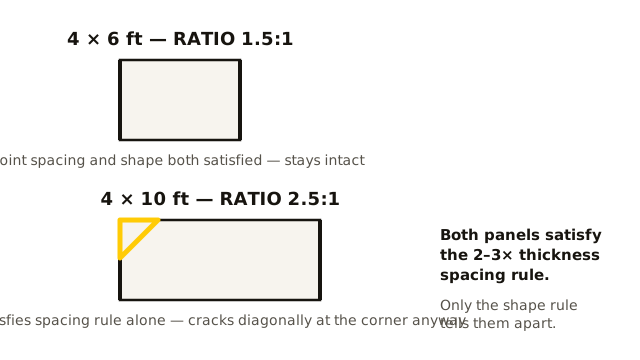
Spacing alone doesn't prevent cracking — the panel's length-to-width ratio also has to stay at or under 1.5:1. A panel more elongated than that tends to crack diagonally at the corners regardless of how well the spacing rule was followed.
This is exactly the shape people pour most: a 4-foot-wide sidewalk with joints every 10 feet satisfies the spacing rule but sits at a 2.5:1 ratio. It will very likely crack diagonally at the corners anyway. For a narrow run like a sidewalk, space joints closer than the thickness rule alone suggests — close enough to keep every panel under 1.5:1.
Saw-cut joints also need to be deep enough to actually control the crack: at least a quarter of the slab's thickness, so a 4-inch slab needs a 1-inch-deep cut and a 6-inch slab needs 1.5 inches. A shallow scored line that doesn't reach that depth won't reliably direct where the concrete cracks. Timing matters too — in hot weather, cut within 6 to 12 hours of finishing, and that window can shrink to 2 to 4 hours at 90°F. Early-entry saws that cut shallower (1 to 3 inches) can go in almost immediately after finishing and are the standard way to hit a tight window.
The temperature question doesn't have a simple answer
There's no clean "pour between X and Y degrees" rule, and pages that give one are oversimplifying in both directions.
On the cold side there's a real, specific threshold: cold-weather procedures apply below 40°F. That's not a prohibition — it triggers a protection period (commonly 1 to 4 days for mixes with accelerators) during which the concrete needs to be kept warm enough to cure properly. You can pour below 40°F; you just have to protect the pour.
On the hot side there's no code-specified maximum temperature at all. What hot weather actually does is speed up evaporation and hydration, which stiffens the mix faster than a crew can place and finish it — and the common fix on-site, adding water at the truck, is the actual failure mode: it reduces strength, increases shrinkage, and causes more cracking, not less. Framing hot-weather pours around "don't let anyone add water at the truck" is more useful than any temperature number.
A 4-inch compacted gravel base under a 20×20 ft slab: 400 sq ft × (4 ÷ 12) ft = 133 cubic feet = about 4.9 cubic yards — and that's before accounting for compaction, which reduces loose volume further. See the gravel calculator to size your specific base; this calculator only covers the concrete on top of it.
Before you buy
- Above roughly 1 to 2 cubic yards, a ready-mix delivery usually beats bags on both price and labor. See concrete cost per yard to compare.
- Compact 4 inches of gravel under the slab before you pour. Use the gravel calculator to size that base separately — it's not included here.
- Space control joints every 2 to 3 times the slab thickness in feet, and keep every panel's length under 1.5 times its width — a narrow run like a sidewalk needs closer joints than the thickness rule alone suggests, or it cracks diagonally anyway.
- Order 5 to 10% extra on ready-mix deliveries too. Trucks round up to a quarter yard and a short pour means a second, more expensive small-load delivery.
- Below 40°F, plan on protecting the pour rather than avoiding it. Above 40°F there's no simple ceiling — the real risk is water added at the truck to fight stiffening in the heat.
Common questions
How much concrete do I need for a slab?
Multiply length by width by thickness (in feet) to get cubic feet, divide by 27 for cubic yards, or divide by the bag yield for bag count. A 10×10 ft slab 4 inches thick needs about 1.36 cubic yards or 62 80-lb bags.
How thick should a concrete slab be?
4 inches is standard for patios, walkways and shed floors. Driveways and garage floors that carry vehicles should be 5 to 6 inches, and areas with heavy trucks may need more with reinforcement.
When do bags stop making sense and I should order ready-mix?
Most contractors switch to a ready-mix truck somewhere around 1 to 2 cubic yards, which is roughly a 10×10 ft slab at 4 inches. Mixing 60-plus bags by hand takes a full day; a truck pours it in minutes.
Do I need gravel under a slab?
Yes, for anything permanent. A 4-inch compacted gravel base drains water away and keeps the slab from cracking as the ground shifts. It's not included in this calculator; see the gravel calculator to size the base separately.
Should I add wire mesh or rebar?
For 4-inch walkways and patios, welded wire mesh is common practice. Driveways and garage floors typically use rebar on a grid. Either way it doesn't change the concrete volume.