How Thick Should a Concrete Slab Be?
Four inches covers most residential slabs — patios, walkways, shed floors, and driveways carrying only cars. Five to six inches where trucks, RVs, or other heavy vehicles regularly drive. Past that, thickness is usually not the thing that actually determines whether the slab holds up.
Quick answer, by use
| Application | Typical thickness |
|---|---|
| Patio, walkway, garden path | 4 in |
| Shed or small outbuilding floor | 4 in |
| Residential garage floor | 4 in, commonly 5–6 for heavier vehicles |
| Driveway — cars only | 4 in |
| Driveway — trucks, RVs, regular heavy vehicles | 5–6 in |
| Slab foundation for a structure | Engineered — not a rule-of-thumb question |
Anything structural, permitted, or carrying an unusual load is a design question for an engineer, not a lookup table.
Why thickness is rarely what actually failed
When a residential slab fails, the thickness itself is rarely the cause. The usual culprits are a poor or uneven base, no control joints or joints cut too late, edges that weren't thickened where loads actually arrive, water added at the truck to make placement easier, or inadequate curing. A 4-inch slab on a properly prepared base will consistently outperform a 6-inch slab on a bad one — which follows directly from how a slab on grade actually works: it carries load by bearing on what's underneath it, not by spanning like a beam. A page that only lists thicknesses is missing the more useful half of the question.
Thickened edges: why the middle of the slab isn't where it breaks
Edges take more stress than the field of the slab for a few compounding reasons: vehicles load a driveway right at the point they drive onto it, which is the moment of maximum stress; the middle of a slab is confined on all sides while an edge isn't, so it can rotate and settle more easily; edge soil freezes first and deepest, concentrating frost heave there; and water running off the slab erodes the soil right at the perimeter. The classic result is cracking that runs parallel to and just inside the edge, or a broken-off edge strip.
Someone debating 4 inches versus 6 inches across an entire driveway is looking at roughly 50% more concrete for the whole job. Thickening just the edges and the vehicle apron into a small integral beam — sometimes called a turned-down or thickened edge — addresses the actual failure mode for meaningfully less material, leaving budget for a better base instead. Depth and width of a thickened edge vary by application and local code, so verify the specifics for anything permitted.
The base matters more than the inch you're debating
A slab on grade doesn't span — it bears. What it bears on decides how it performs. A base does four jobs: it gives the slab uniform support so it isn't spanning between high spots and developing bending stress it was never designed for; it drains water away from under the slab, since trapped moisture is both a freeze-heave path and a moisture source; it forms a capillary break, with open-graded stone interrupting moisture rising from the soil; and it gives you a platform you can actually compact, since many subgrades can't be properly compacted on their own.
Using rounded gravel instead of angular crushed stone is the first — pea gravel looks like base material but can't be compacted into a structural base, so the slab above it settles unevenly and the failure gets blamed on thickness or mix instead of the base. Placing the base in one thick lift is the second — a compactor only densifies to a limited depth, so a single thick lift leaves the bottom uncompacted, exactly where the load ends up. There's a quieter third mistake too: compacted material occupies less volume than loose material, so you have to order for loose volume to hit a compacted depth — the most common reason people run short on base stone. Use the gravel calculator to size the base, and see its notes on compaction allowance.
Joints: the rule most people only half-know
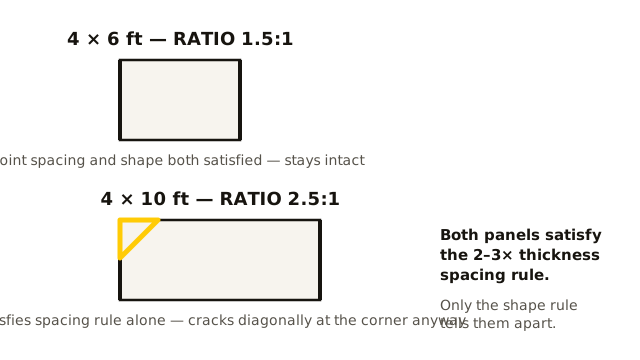
Control joints are commonly spaced at 2 to 3 times the slab thickness in inches, read as feet — a 4-inch slab gets joints every 8 to 12 feet, a 6-inch slab every 12 to 18 feet. Saw cuts need to reach at least a quarter of the slab's thickness to actually control where cracking happens: 1 inch on a 4-inch slab, 1.5 inches on a 6-inch slab. In hot weather, cut within 6 to 12 hours of finishing — that window can close to 2 to 4 hours at 90°F, which is where early-entry saws that cut shallower and can be used almost immediately after finishing earn their keep.
Spacing alone doesn't prevent cracking — the panel's length-to-width ratio also needs to stay at or under 1.5:1, and both constraints have to be satisfied at the same time. A 4-foot-wide walk with joints every 10 feet satisfies the spacing rule and sits at a 2.5:1 ratio, which very likely cracks diagonally at the corners anyway. For a 4-foot walk, joints every 6 feet keep the ratio at 1.5:1 — tighter than the spacing rule alone would suggest, and exactly why sidewalks crack diagonally at the corners so often. Thickness doesn't fix this; joint layout does. This is covered in more depth on the slab calculator.
What reinforcement does — and doesn't do
Welded wire mesh holds cracks tightly closed once they've formed; it doesn't prevent them from forming. Rebar adds flexural capacity and crack control where it's actually designed for a specific load. Fiber controls plastic shrinkage cracking in the first few hours after placement but isn't a structural substitute for either. The common misunderstanding is expecting any of these to stop cracking altogether — concrete shrinks as it cures and it will crack regardless; reinforcement and joints determine where and how wide, not whether. Mesh also only works if it's actually positioned within the slab rather than left lying on the subgrade, which requires chairs or pulling it up partway through the pour.
Getting the thickness you actually paid for
The finished surface of a slab is set by the forms and the screed. The bottom is set by the subgrade. If the subgrade has high spots, the slab is thinner over them — and the high spots are exactly where the slab is under the most stress. A slab that's nominally 4 inches can be 2.5 inches in the worst spots, which is precisely where it cracks first. The fix is cheap: grade the base carefully, check it with a string line or level, and cut down high spots rather than filling low ones with extra concrete. This is also a real quantity issue, since an uneven subgrade consumes more concrete than the calculation predicts — one legitimate reason to build in a waste allowance.
Worked example: what thickness actually costs you
Concrete yield scales inversely with thickness — one cubic yard covers about 81 sq ft at 4 inches, 65 sq ft at 5 inches, and 54 sq ft at 6 inches. For a 10×10 ft slab specifically:
| Thickness | Cubic yards | 50-lb bags | 60-lb bags | 80-lb bags |
|---|---|---|---|---|
| 3 in | 1.02 | 74 | 62 | 46 |
| 4 in | 1.36 | 98 | 82 | 62 |
| 5 in | 1.70 | 123 | 102 | 77 |
| 6 in | 2.04 | 147 | 123 | 92 |
Includes 10% waste. Going from 4 to 6 inches on this same footprint is exactly a 50% increase in concrete — the same ratio holds at any slab size, since it's a function of thickness alone.
Use the calculator below to run your own dimensions and compare thicknesses directly:
A 10×10 ft slab poured 4 in thick needs about 62 80-lb bags of concrete, or 1.36 cubic yards of ready-mix — that's roughly 5,000 lb of concrete.
Mistakes worth avoiding
- Debating thickness while ignoring the base — the base is the more common cause of real-world slab failure.
- Using rounded gravel as base material — it can't compact into a structural base.
- Placing the base in one thick lift — the bottom stays uncompacted.
- Skipping a thickened edge on a driveway — edges are where vehicles load the slab and where it breaks first.
- Spacing joints by rule but ignoring panel shape — elongated panels crack diagonally regardless of spacing.
- Cutting joints too shallow — under a quarter of the slab's thickness, a joint doesn't control anything.
- Expecting reinforcement to prevent cracks — it controls them; it doesn't stop them from forming.
- Adding water at the truck — every extra gallon per cubic yard costs roughly 200 psi of strength. See the mix ratios guide for why.
Common questions
How thick should a concrete slab be for a patio or walkway?
4 inches, which covers normal foot traffic and residential use over a properly prepared base.
How thick should a driveway slab be?
4 inches for cars only; 5 to 6 inches where trucks, RVs, or other heavy vehicles regularly drive.
Does a thicker slab prevent cracking?
Not on its own. Most residential slab cracking traces back to the base, the joint layout, or the edges — not the thickness. A 4-inch slab on a properly prepared base will outperform a 6-inch slab on a bad one.
How much more concrete does a 6-inch slab need compared to 4 inches?
About 50% more, for the same footprint. Going from 4 to 6 inches is a real cost increase, which is why it's worth checking whether the money is better spent thickening just the edges and improving the base instead.
How thick should a slab foundation be for a structure?
That's an engineered question, not a rule-of-thumb one — it depends on the structure's loads and your local soil conditions. Any slab that will support a building needs a design from a qualified engineer, not a lookup table.