Sonotube Concrete Calculator
A 12-inch sonotube 48 inches tall needs about 6 80-lb bags of concrete per tube — 3.46 cubic feet total for 1 tube(s).
Bags per tube for common sonotube sizes
| Diameter | Height | Cubic feet | 50-lb bags | 60-lb bags | 80-lb bags |
|---|---|---|---|---|---|
| 8 in | 36 in | 1.15 | 4 | 3 | 2 |
| 8 in | 48 in | 1.54 | 5 | 4 | 3 |
| 10 in | 36 in | 1.80 | 5 | 4 | 3 |
| 10 in | 48 in | 2.40 | 7 | 6 | 4 |
| 12 in | 36 in | 2.59 | 7 | 6 | 5 |
| 12 in | 48 in | 3.46 | 10 | 8 | 6 |
| 16 in | 48 in | 6.14 | 17 | 14 | 11 |
| 18 in | 48 in | 7.78 | 21 | 18 | 13 |
| 24 in | 48 in | 13.82 | 37 | 31 | 24 |
Per tube, includes 10% extra. Multiply by your tube count.
How the math works
A sonotube is a cylinder, so its volume follows the standard formula for a circle's area times height. Diameter and height are usually given in inches, and the result gets converted to cubic feet by dividing by 1728 (the number of cubic inches in a cubic foot).
cubic feet per tube = π × radius² × height ÷ 1728
bags = (cubic feet × tube count × 1.10) ÷ bag yield
Bag yields used here are the manufacturer figures for placed concrete: 0.375 cubic feet from a 50-lb bag, 0.45 from a 60-lb bag, 0.60 from an 80-lb bag.
Why diameter matters more than depth
Depth and diameter solve two completely different problems. Depth gets you below the frost line, which stops the footing from being pushed up by freezing soil. Diameter determines bearing area, which determines whether the footing sinks under load in the first place. Going deeper doesn't add any bearing capacity — only a wider footprint does that, and because a circle's area scales with the square of its diameter, small jumps in diameter add capacity fast.
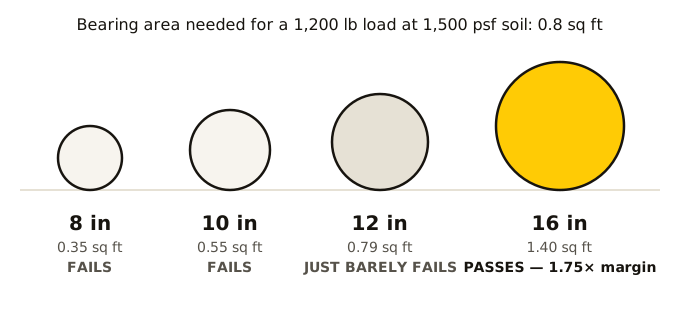
At a common default soil bearing value of 1,500 lb per square foot, a 1,200-lb point load needs about 0.8 sq ft of bearing area to avoid overloading the soil. Here's what different tube diameters actually provide:
| Diameter | Bearing area | Capacity at 1,500 psf |
|---|---|---|
| 8 in | 0.35 sq ft | ~525 lb — fails |
| 10 in | 0.55 sq ft | ~825 lb — fails |
| 12 in | 0.79 sq ft | ~1,185 lb — just barely fails |
| 16 in | 1.40 sq ft | ~2,100 lb — passes, 1.75× margin |
Going from 12 to 16 inches very nearly doubles bearing capacity, for a footing that's still easy to hand-dig. That's the actual argument for sizing up a diameter, not comfort or convention.
In practice, 12 inches tends to suit light-duty decks and low posts in good soil (2,000+ psf), 14 to 16 inches covers standard residential decks under moderate load, 18 inches is a common default in many jurisdictions, and 20 to 24 inches shows up for heavy loads, snow country, poor soil, or multi-level decks. If you'd rather work from a square footing instead of round, a square with side length equal to about 0.886 times the round diameter gives roughly the same bearing area.
Depth, diameter, and wind all fail differently
| Question | Governed by | Failure if wrong |
|---|---|---|
| Will it sink? | Diameter (bearing area) | Settlement |
| Will it heave? | Depth | Frost lifts the base each winter |
| Will it pull out? | Depth + embedment/connection | Uplift — relevant for tall posts, pergolas, carports |
| Will it tip? | Depth and diameter together | Rotation at the base |
Getting the tube's bottom below frost depth stops the base from being pushed up. It doesn't stop adfreeze — soil freezing to the sides of the tube and lifting it by friction alone, independent of what's happening at the bottom. This is why a smooth-sided tube is preferred over a rough hand-dug hole in frost country, and it's the real argument for a belled footing: a bell mechanically resists being pulled up, because the soil above it would have to lift too.
Belled vs. straight-sided
| Straight-sided | Belled | |
|---|---|---|
| Bearing area | Set by tube diameter | Set by the (larger) bell diameter |
| Uplift resistance | Relies on skin friction and weight | Bell mechanically resists uplift |
| Frost adfreeze | More vulnerable | Bell anchors against it |
| Forming | Simple tube | Needs a bell former, hand-dug bell, or bell auger |
| Typical use | Most decks, light structures | Frost country, uplift conditions, poor soil |
This calculator's volume math assumes a straight cylinder. A belled footing adds a frustum-shaped volume at the base on top of that — if you're belling the footing, add that extra volume separately; it can meaningfully increase the concrete order for a relatively small forming effort.
Before you buy
- Cut the tube a few inches taller than you need — it's easier to trim a form flush after backfilling than to add height to a form that's too short.
- Brace the tube plumb before pouring. A leaning tube sets a leaning footing that's difficult to correct later.
- For post-and-beam decks, set a post anchor into the wet concrete at the top of the pour so the post bolts down rather than sitting directly on concrete.
- If you're pouring more than 4 or 5 tubes, price out ready-mix delivered by chute versus buying that many bags — see concrete cost per yard.
- Strip the cardboard tube once the concrete has cured for a few days; it's meant to be removed, not left in the ground.
Common questions
How much concrete fills a sonotube?
A 12-inch diameter tube 48 inches tall holds about 3.46 cubic feet, roughly 6 80-lb bags. Volume scales with the square of the diameter, so a 24-inch tube holds four times as much as a 12-inch tube of the same height.
What size sonotube do I need for a deck post?
8 or 10 inches is common for typical deck footings, sized up to 12 inches or more for larger decks or poor soil. Local code usually sets a minimum footing diameter and depth, so check before you dig.
How deep should a sonotube footing go?
Below the frost line, the same rule as fence posts — commonly 36 to 48 inches in colder climates and as little as 12 inches in the Deep South. Your building department has the exact number for your area.
Do I need to fill the whole tube with concrete?
Yes, for a solid footing. Some installers bell the bottom wider than the tube for extra bearing area — that added volume isn't included here, so add a little extra concrete if you bell the base.
Can I pour multiple tubes with one calculation?
Yes, enter the number of tubes and this calculator multiplies the per-tube volume automatically, as long as they're all the same diameter and height.