Concrete Curb Calculator
50 ft of curb, 6 in wide and 18 in tall, needs about 69 80-lb bags of concrete — 1.53 cubic yards if you order ready-mix.
Bags needed for common curb sizes
| Length | Width | Height | Cubic yards | 50-lb bags | 60-lb bags | 80-lb bags |
|---|---|---|---|---|---|---|
| 20 ft | 6 in | 18 in | 0.61 | 44 | 37 | 28 |
| 50 ft | 6 in | 18 in | 1.53 | 110 | 92 | 69 |
| 100 ft | 6 in | 18 in | 3.06 | 220 | 184 | 138 |
| 50 ft | 6 in | 24 in | 2.04 | 147 | 123 | 92 |
| 50 ft | 8 in | 18 in | 2.04 | 147 | 123 | 92 |
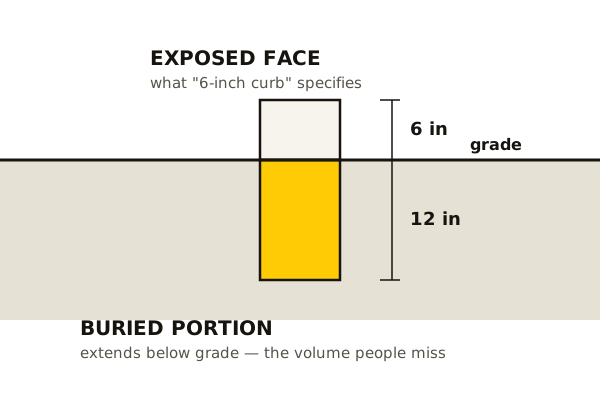
Includes 10% extra. Curb height here includes any buried portion below grade — measure the full poured height, not just what shows above ground.
How the math works
A curb is a long, narrow rectangular prism running the length of the driveway, bed edge, or parking area — the same shape as a footing, just described by width and height instead of width and thickness.
cubic yards = cubic feet ÷ 27
bags = (cubic feet × 1.10) ÷ bag yield
Bag yields used here are the manufacturer figures for placed concrete: 0.375 cubic feet from a 50-lb bag, 0.45 from a 60-lb bag, 0.60 from an 80-lb bag.
Curb is specified by its exposed face — "6-inch curb" means 6 inches showing above the pavement. The actual poured cross-section extends below the pavement surface too, and on a curb-and-gutter section it also extends horizontally into the gutter pan. Someone who calculates volume from only the exposed height will under-order, sometimes badly: a standard curb-and-gutter cross-section can easily run two to three times the area of just the exposed rectangle. On a 200-foot run, that's the difference between ordering 4 cubic yards and actually needing 10.
The fix is simple: measure and enter the full poured cross-section, including whatever sits below grade, not just what will show once it's in.
Slip-form vs. hand-formed
Slip-forming extrudes curb continuously through a machine-driven mold using a stiff, low-slump mix that holds its shape immediately. It's fast and highly consistent on long straight runs, which is why it's standard on commercial, municipal, and subdivision work — but the mobilization cost is high, so it only pays off with substantial linear footage, and tight radii or driveway aprons are often still finished by hand regardless. Hand-forming — wood or steel forms built in place — handles any geometry, has no mobilization cost, and is the realistic choice for most short residential runs and repairs. It's slower, and because it depends more on the crew and the forms holding their shape, it's worth carrying a somewhat higher waste allowance than you would for a machine-consistent slip-formed section.
Before you buy
- Measure the full poured height, including the portion that will be buried below the final grade — it's easy to only count what shows above ground.
- For long, continuous runs, a slip-form curbing machine or a ready-mix delivery is usually far faster than mixing bags one at a time — see concrete cost per yard.
- Use flexible form boards or a curbing form to hold a consistent radius on curves; curb volume doesn't change much on a gentle curve, but the layout work does.
- Tool a control joint every 6 to 10 feet on straight runs to control where cracking happens.
Common questions
How much concrete does a curb need?
Multiply the run length in feet by the width and height in inches, converting inches to feet first. 50 feet of standard 6-inch by 18-inch curb needs about 1.53 cubic yards, or 69 80-lb bags.
What size is a standard driveway curb?
Landscape edging curb is commonly 6 inches wide by 18 to 24 inches tall, including the buried portion below grade. Street and parking-lot curbs follow local municipal standards, which are often larger.
Is landscape curbing the same as a poured driveway curb?
Not always. Decorative landscape edging curb is a smaller, often machine-extruded product, while a driveway or parking curb is typically hand-formed or slip-formed to a taller, thicker profile. This calculator works for either as long as you enter the actual width and height.
Do curbs need rebar?
Small landscape edging usually doesn't. Structural driveway or parking lot curbs, especially taller ones, often use a single continuous rebar rod for crack control — check local practice or code for your application.
How is a curb different from a footing calculation?
The math is the same shape — a long, narrow rectangular prism — but curbs are usually described by width and height (how tall it stands), while footings are described by width and thickness (how deep it sits). Use whichever matches how your project is dimensioned.